
SkincareSkincare TipsSkincare RoutineBeauty TipsSkincare IngredientsSkincare MistakesRetinolVitamin CSalicylic AcidAHABHAAcne SkincareHealthy SkinSkin Care ProductsBeauty HacksSkin Health
The Skincare Products You Should NEVER Mix Together: 7 Combinations to Avoid
Mixing the wrong skincare ingredients can cause irritation, dryness and sensitivity. Learn which skincare products to separate and how to build a safer routine.
August 12, 2026
Have you ever bought several skincare products because each one promised to give you clearer, brighter, smoother or younger looking skin?
You start with a cleanser, add a vitamin C serum, then retinol, an exfoliating acid, maybe a spot treatment and suddenly your skin is red, dry, burning or breaking out. The problem may not be that your products are bad. It could be that you are using too many powerful ingredients at the same time. Skincare is not always about using more products. Sometimes, the secret to healthier looking skin is knowing which ingredients work well together and which ones are better separated.
Some combinations can increase dryness and irritation, particularly when several potentially irritating actives are introduced together. For example, Cleveland Clinic notes that both retinol and salicylic acid can dry and irritate the skin, while vitamin C and retinol can both cause irritation when introduced together. So before you layer every serum in your bathroom cabinet, here are skincare combinations you should think twice about.
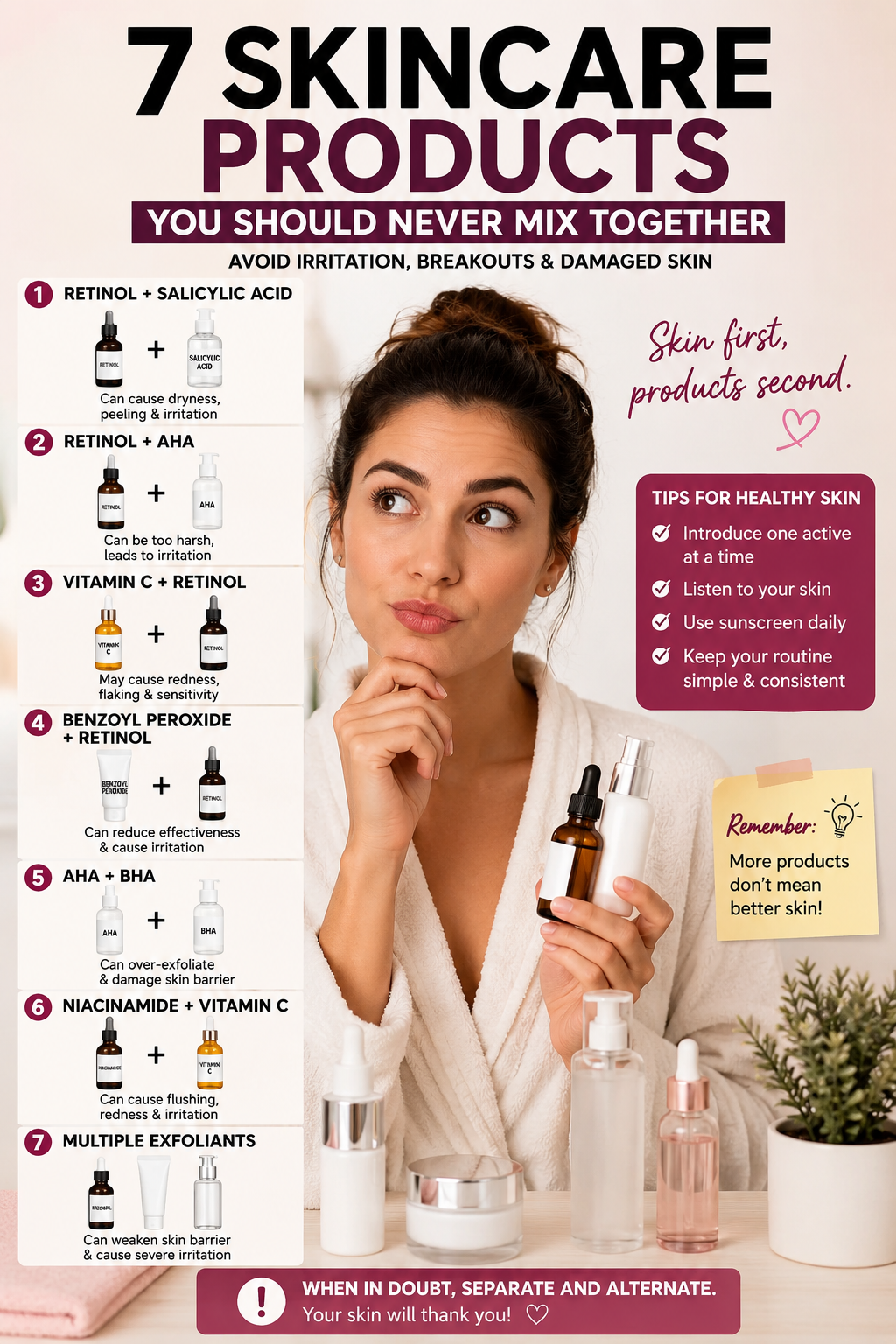
1. RETINOL + SALICYLIC ACID
Both retinol and salicylic acid can be useful ingredients. Retinol is commonly used for concerns such as acne, fine lines and uneven skin texture, while salicylic acid is often used to help unclog pores and manage acne. The problem is that both can be drying and irritating. Using them together in the same routine may leave some people experiencing:
- Dryness
- Flaking
- Redness
- Stinging
- Increased sensitivity
That doesn’t mean you can never use both. A better approach may be to alternate them. For example, you could use salicylic acid on one evening and retinol on another, depending on your skin’s tolerance and the instructions on your products. Cleveland Clinic specifically suggests separating these ingredients rather than automatically using them together.
A simpler routine
Morning:
Gentle cleanser → moisturizer → sunscreen
Night 1:
Cleanser → salicylic acid → moisturizer
Night 2:
Cleanser → retinol → moisturizer
Night 3:
Recovery night with cleanser moisturizer
Repeat according to how your skin responds.
2. RETINOL + STRONG EXFOLIATING ACIDS
Retinol already encourages skin cell turnover. Adding a strong exfoliating acid such as glycolic acid or another AHA on the same night can create a routine that is simply too aggressive for some skin types. AHAs such as glycolic and lactic acid work by exfoliating the surface of the skin. The FDA notes that AHA products can increase sensitivity to ultraviolet radiation and recommends sun protection when using them. If your skin becomes tight, unusually sensitive, red or flaky after combining these products, that’s a sign to simplify your routine.
Try this instead:
Use your AHA on a separate night from your retinol. For example:
Monday: Retinol
Tuesday: Moisturizer/recovery
Wednesday: AHA
Thursday: Moisturizer/recovery
Friday: Retinol
You don’t need to exfoliate every night to have healthy skin.
3. VITAMIN C + RETINOL
Not Necessarily Forbidden, But Don’t Rush It. This is one of the most misunderstood skincare combinations. You may see people online saying that vitamin C and retinol should never be used together. That’s too simplistic. Both ingredients can have useful roles in a skincare routine. The bigger concern is that both can irritate the skin, especially when someone is new to active ingredients. Cleveland Clinic notes that vitamin C and retinol can be used as part of an overall routine, but recommends introducing them gradually and using vitamin C in the morning and retinol at night.
A simple way to separate them:
AM:
Vitamin C → moisturizer → sunscreen
PM:
Retinol → moisturizer
This gives you the benefits of both without putting all your active ingredients into one routine.
4. BENZOYL PEROXIDE + RETINOL
Check Which Retinoid You’re Using. This combination needs a little more explanation because not all retinoids behave exactly the same way. Benzoyl peroxide is commonly used in acne routines, while retinoids can also be used for acne and other skin concerns. The important point is that formulation matters. Some older retinoid formulations can be affected by benzoyl peroxide, while adapalene is designed to be used with benzoyl peroxide. So don’t assume that every retinoid and every benzoyl peroxide product should automatically be layered together.
If you’re using prescription acne treatment, follow the instructions from your dermatologist or pharmacist rather than copying a routine from social media. And if you’re using over the counter products, read the product directions carefully. More acne products do not automatically mean faster results.
5. AHA + BHA
AHA and BHA are both exfoliating ingredients. Common AHA ingredients include:
- Glycolic acid
- Lactic acid
Salicylic acid is the most common BHA found in cosmetic products. Using both can be appropriate in some carefully formulated products or routines, but layering multiple exfoliants can be too much for sensitive or already irritated skin.
Possible signs that you’ve overdone exfoliation include:
- Burning
- Persistent stinging
- Peeling
- Redness
- Increased sensitivity
- A tight or uncomfortable feeling
If you want to use both, consider separating them across different days instead of applying them one after another. And remember if your skin is already irritated, adding another exfoliant isn’t usually the solution.
6. MULTIPLE PRODUCTS CONTAINING THE SAME ACTIVE INGREDIENT
This mistake is surprisingly easy to make. Imagine your routine contains:
- A cleanser with salicylic acid
- A salicylic acid toner
- A salicylic acid serum
- A spot treatment containing salicylic acid
You may think you’re using four different skincare products. Your skin may simply see a lot of the same active ingredient. The same thing can happen with retinol, exfoliating acids and other active ingredients. Cleveland Clinic recommends avoiding unnecessary duplication of anti aging ingredients across products because doubling up isn’t automatically better. Before buying another serum, check the ingredient list. You might already have what you need. Sometimes the best skincare routine isn’t the one with 10 steps. It’s the one you can use consistently without irritating your skin.
7. EXFOLIATING ACTIVES + ALREADY IRRITATED SKIN
This isn’t technically a product to product combination, but it’s one of the biggest skincare mistakes.
If your skin is already:
- Burning
- Peeling
- Extremely dry
- Red
- Tender
- Stinging when you apply moisturizer
don’t keep adding powerful actives simply because they’re part of your normal routine. Your skin may need a reset. For a few days, consider keeping things simple
Gentle cleanser → moisturizer → sunscreen in the morning.
Once your skin feels comfortable again, gradually reintroduce active ingredients rather than immediately returning to everything at once.
SO WHAT CAN YOU SAFELY USE TOGETHER?
A simple skincare routine can actually be more effective than a complicated one.
Morning
1. Gentle cleanser
Remove sweat, oil and overnight buildup without aggressively stripping your skin.
2. Vitamin C optional
If your skin tolerates it, vitamin C can be included in your morning routine.
3. Moisturizer
Choose one appropriate for your skin type.
4. Sunscreen
This step is especially important when you’re using exfoliating ingredients. FDA guidance notes that AHAs may increase sensitivity to the sun and recommends sunscreen, protective clothing and limiting sun exposure when using them.
Night
1. Cleanser
2. One main active
Choose either your retinol, an exfoliating acid or another treatment appropriate for your skin.
3. Moisturizer
Give your skin the hydration and support it needs.
The “Less Is More” Rule for Skincare. One of the biggest skincare myths is that adding more products will automatically produce better results. It doesn’t work that way. If you introduce five powerful products at once and your skin becomes irritated, you may not even know which product caused the problem. Instead, introduce one new active at a time. Give your skin time to adjust, Pay attention to how it feels and don’t confuse irritation with effectiveness.
Burning doesn’t mean a product is working better. Peeling doesn’t automatically mean you’re getting rid of “bad skin. And extreme dryness isn’t the price you have to pay for beautiful skin. Your goal should be healthy, comfortable skin not the most complicated skincare shelf.
FINAL THOUGHTS
Skincare isn’t about collecting the biggest number of serums. It’s about understanding what your skin needs and using products strategical. Retinol, vitamin C, AHAs, BHAs and other active ingredients can all have a place in a skincare routine. But combining too many potentially irritating products at once can make your skin unhappy.
If you’re unsure, start simple. Cleanse, Moisturize, Protect your skin from the sun and then add one active at a time.
And always follow the directions on your specific product because formulations and concentrations vary. Your skin doesn’t need a chemistry experiment every night. Sometimes, a simpler routine is the glow up
0
Comments
Sign in to leave a comment.