
Makeup TipsBeauty TipsMakeup MistakesMakeup For PhotosPhotography MakeupFoundation TipsBeauty HacksSkincare And MakeupMakeup TutorialBeauty Guide
# Why Your Makeup Looks Flawless in the Mirror but Bad in Photos
Wonder why your makeup looks perfect in the mirror but bad in photos? Discover how lighting, foundation, powder, flash, concealer, and camera angles affect your makeup.
August 11, 2026
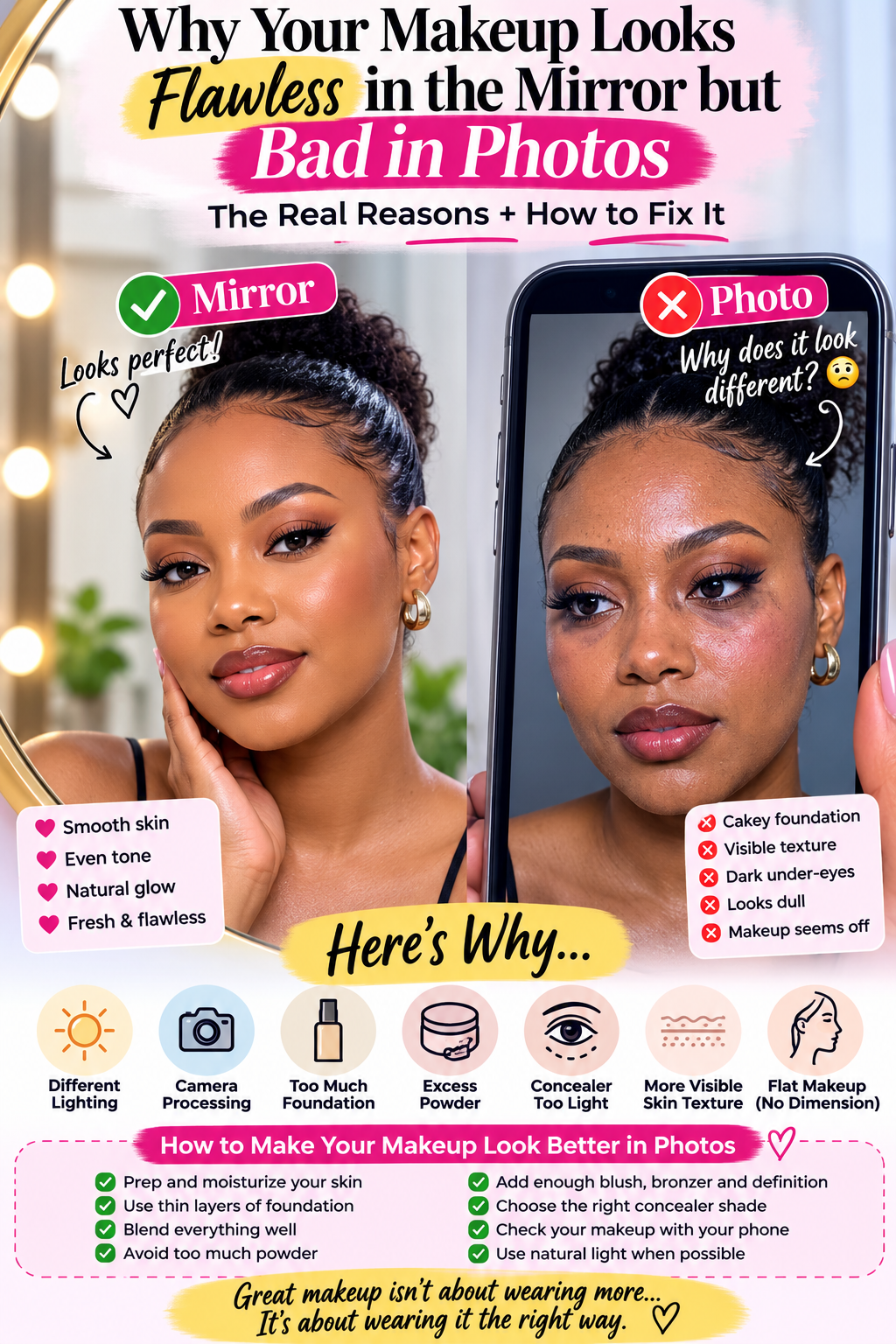
Have you ever finished your makeup, looked in the mirror, and thought, “Wow, my makeup looks perfect today!” only to take a photo and suddenly notice a cakey foundation, obvious texture, dark under-eyes, or a face that looks completely different?
You’re not imagining it.
Makeup can genuinely look different in person compared with how it appears through a smartphone camera. Lighting, camera processing, foundation texture, flash, makeup placement, and even the distance between your face and the camera can all change the final result.
The good news? You don’t necessarily need more makeup. You may simply need to adjust how you apply it for the camera.
Here are the most common reasons your makeup looks flawless in the mirror but not in photos and what you can do about them.
YOUR BATHROOM OR BEDROOM LIGHTING IS HIDING IMPERFECTIONS
One of the biggest reasons makeup looks different in photos is lighting. Warm indoor lights can make your skin appear smoother and more even than it actually looks under natural or camera lighting. Some lights also reduce the appearance of shadows and texture. Then you step outside or stand in front of a camera, and suddenly every little detail becomes more visible.
What to do
Whenever possible, apply your makeup near soft natural daylight. If you’re getting ready for an event where you’ll be photographed, check your makeup in lighting similar to where the photos will be taken. Avoid relying only on strong overhead lighting because it can create shadows under the eyes, nose, and cheekbones.
2. YOUR FOUNTAIN MAY BE TOO HEAVY
Foundation can look beautiful in person while appearing thick or cakey in photographs. This often happens when too much product is applied, especially around the nose, mouth, forehead, and under-eye area. Cameras can emphasize layers of makeup that your eyes don’t notice in the mirror.
The solution
Instead of applying a thick layer everywhere, start with a thin layer and build coverage only where you need it. Use a damp makeup sponge or suitable foundation brush to blend the product carefully into the skin.
Remember:
More foundation doesn’t always mean better-looking skin. For photographs, natural-looking skin often looks better than a heavy, completely covered complexion.
3. YOUR SKIN TEXTURE IS MORE VISIBLE ON CAMERA
Even when your skin looks smooth in the mirror, cameras can pick up texture. Foundation sitting on dry patches, enlarged pores, fine lines, or flaky skin may become much more noticeable in close-up photos. This is especially common when makeup is applied over dehydrated skin. Before applying makeup
Try to prepare your skin properly:
* Cleanse gently.
* Apply a lightweight moisturizer.
* Give your skincare time to absorb.
* Use a primer if it works well with your skin type.
* Avoid applying excessive skincare immediately before foundation.
Well-prepared skin can help makeup sit more evenly.
4. FlASH CAN CHANGE EVERYTHING
Flash photography can make certain makeup mistakes much more obvious. Some products can reflect light, making areas of the face appear unusually bright or pale in photographs. This is sometimes called flashback. It can be especially noticeable when using certain powders or products containing highly reflective ingredients.
How to avoid it
If you know you’ll be photographed with flash, test your makeup beforehand. Take a photo using the same type of lighting and check your face from different angles. Don’t rely only on how the makeup looks in your bathroom mirror.
5. YOUR CONCEALER MAY BE TOO LIGHT
A bright under-eye can look beautiful in person, but if the concealer is significantly lighter than your skin tone, photographs may exaggerate the contrast. Instead of making your eyes look naturally lifted, the area can appear unusually white or grey.
Try this instead
Choose a concealer that is close to your natural skin tone for covering imperfections. If you want a brighter under-eye, go only slightly lighter rather than several shades lighter. Blend the edges carefully so there isn’t an obvious transition between the concealer and the rest of your face.
6. TOO MUCH POWER CAN MAKE YOUR SKIN LOOK DRY
Powder is useful for controlling shine, but using too much can make your skin appear flat, dry, or cakey in photographs. This is especially noticeable around the under-eyes and areas with fine lines.
A better approach
Apply powder strategically rather than covering your entire face with a thick layer. Focus on areas where you genuinely need oil control. If your skin is naturally dry, a lighter amount of powder may create a more natural finish.
7. YOUR CONTOUR AND BLUSH MAY NOT BE STRONG ENOUGH FOR THE CAMERA
Here’s something interesting: makeup that looks perfectly defined in the mirror can sometimes disappear in photographs. Cameras flatten some of the dimension of the face, especially when you’re using soft lighting. As a result, your blush, bronzer, and contour may not show as much as they did in person.
The trick
You don’t necessarily need dramatic contouring. Instead, slightly enhance your natural features:
* Add a little blush to the cheeks.
* Use bronzer to add warmth.
* Define the cheekbones subtly.
* Add a small amount of highlight where appropriate.
The goal is definition without looking heavily made up.
8. YOUR CAMERA IS PROCESSING YOUR FACE
Modern smartphones don’t simply capture an untouched image. Your phone may automatically adjust exposure, contrast, sharpness, color, and other aspects of the image. This can change how your skin and makeup appear. A camera may also emphasize details that aren’t obvious to your eyes. That’s why your makeup can look completely different in a selfie compared with what you see in the mirror.
Try this
Take a few test photos before leaving the house. Move closer to a window, change your angle, and experiment with different distances from the camera. Sometimes the problem isn’t your makeup—it’s simply the camera setup.
9. YOU’RE LOOKING AT YOUR FACE FROM A DIFFERENT PERSPECTIVE
A mirror shows your face from a familiar perspective. A photograph freezes one particular angle. Suddenly, you may notice that your eyeliner isn’t perfectly symmetrical, your blush sits slightly differently on each cheek, or your contour looks stronger on one side. But remember: faces are naturally asymmetrical. Trying to make every detail perfectly identical can actually make makeup look less natural. Instead, aim for overall balance.
10. YOUR MAKEUP MAY NOT MATCH THE OCCASION
Makeup designed for everyday indoor lighting isn’t necessarily the same makeup that works for photography. For example, a very subtle blush may look beautiful during the day but disappear completely in event photos. Likewise, extremely heavy foundation may look appropriate under stage lighting but appear cakey in normal photographs. Think about where you’ll be photographed and adjust your makeup accordingly.
HOW TO MAKE YOUR MAKEUP LOOK BETTER IN PHOTOS
If you want your makeup to look beautiful both in person and on camera, try this simple approach:
Step 1: Prepare Your Skin
Start with clean, moisturized skin. Don’t rush straight into foundation.
Step 2: Use Thin Layers
Apply foundation gradually. Build coverage only where needed.
Step 3: Blend Everything Carefully
Pay special attention to the jawline, hairline, nose, and around the mouth.
Step 4: Add Dimension
Use blush, bronzer, and subtle contour to prevent your face from looking flat in photographs.
Step 5: Be Careful With Powder
Set oily areas without covering your entire face in excessive powder.
Step 6: Check Your Makeup With Your Phone
Before an important event, take a test photo using the lighting you’ll likely encounter.
Step 7: Check Your Under-Eyes
Make sure your concealer isn’t too light and that you’ve blended it properly.
Step 8: Don’t Forget Your Neck
A foundation shade that matches your face but doesn’t blend into your neck can become much more obvious in photographs.
MIRROR VS. CAMERA: WHICH ONE SHOULD YOU TRUST?
Neither one is necessarily wrong. The mirror shows you a live three-dimensional version of your face, while a camera captures a two-dimensional image under specific lighting and processing conditions. A photo is simply one representation of how you look from one angle, at one moment, under one set of conditions. So don’t panic if one photo doesn’t look the way you expected. Instead of immediately adding more makeup, first check the lighting, camera angle, distance, and exposure.
The BOTTOM LINE
If your makeup looks flawless in the mirror but disappointing in photos, your makeup may not actually be the problem. Lighting, flash, foundation thickness, powder, skin preparation, camera processing, and angles can all dramatically affect the final image. The secret isn’t necessarily wearing more makeup. It’s learning how your makeup behaves under different lighting and camera conditions.
Start with well-prepared skin, use lighter layers, blend carefully, add enough definition, and always test your makeup with your phone before an important event. Most importantly, don’t chase perfection. Great makeup should enhance your features—not make you feel like you need to hide them.
FREQUENTLY ASKED QUESTIONS
>Why does my foundation look cakey in pictures but fine in person?
Cameras can emphasize texture, dry patches, and layers of foundation that may not be obvious in a mirror. Applying thinner layers and properly moisturizing beforehand can help.
>Why does my face look white in photos?
This can happen because of flash, lighting, or certain highly reflective makeup products. Take a test photo with flash before an event to see how your products react.
>Why does my makeup disappear in photos?
Soft lighting and cameras can reduce the appearance of blush, bronzer, and contour. Slightly enhancing facial definition can help your features show up without making your makeup look heavy.
>Should I wear more makeup for photos?
Not necessarily. Heavy makeup can sometimes look worse in close-up photographs. Focus on good skin preparation, thin layers, proper blending, and strategic definition.
>Why does my face look different in selfies?
Camera lenses, distance, angle, lighting, and image processing can all affect how facial proportions and skin appear. A selfie is not always an accurate representation of how you look in real life.
0
Comments
Sign in to leave a comment.